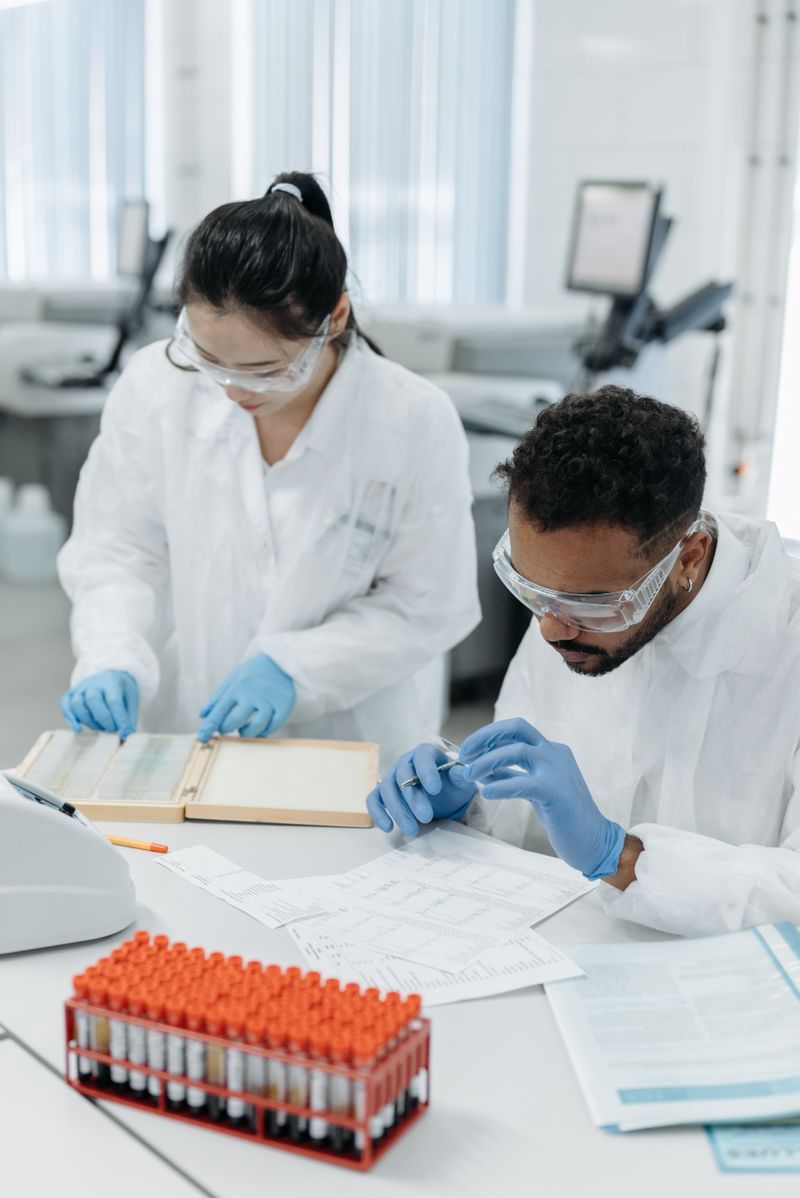
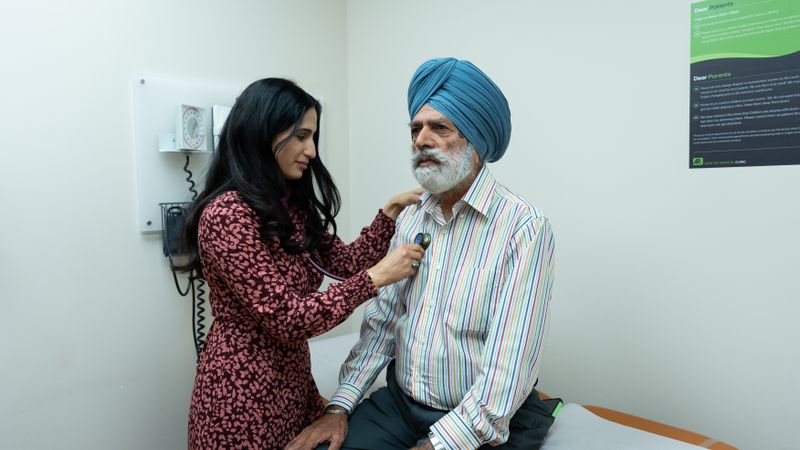
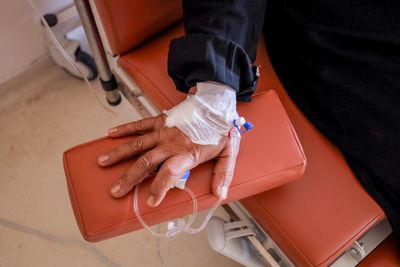
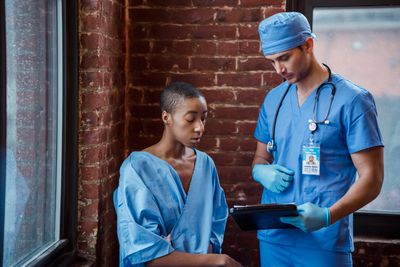
AI systematically underdiagnoses underserved populations. AI classifiers consistently underdiagnose Black, Hispanic, female, and Medicaid-insured patients across chest X-ray datasets (Nature Medicine, 2021). A landmark study found a widely used clinical algorithm identified Black patients for additional care at less than half the rate it should have (Science, 2019).
02
Even collaborative AI approaches don't fix this. When hospitals try to train models together, standard methods average every hospital into one global model. When patient populations differ, the global model is a compromise towards the mean. The equity problem is a data heterogeneity problem (Dinh et al., NeurIPS 2020).
03
No other company focuses on health equity. We directly address this critical market and technological gap.
Every community is different. AI trained on one misses the others.
Federated learning lets hospitals train AI models together without sharing patient data. Each hospital trains locally on its own data, behind its own firewall. Only mathematical model updates leave the building, never patient records.
FedAvg: The Standard Algorithm
The few federated learning implementations in healthcare today use FedAvg, the standard algorithm. It averages every hospital into one global model. Simple and efficient, but one model has to fit everyone.
pFedMe: Goose FL's Approach
We use pFedMe because it lets each hospital keep a model tuned to its own community while still learning from the network. That is what makes health equity possible, and it is why we built our stack around it.
Same privacy guarantees. Same local data. The difference is whether every community gets the same model or its own.
Social Determinants of Health (housing, insurance, transit) and Environmental Determinants of Health (pollution, microclimates) are geographically concentrated and non-IID. When you average these factors across hospitals, you do not smooth statistical noise. You erase structural reality.
🏠
Flattening Resource Deserts
In an academic medical center, a late-stage tumor signals aggressive biology. In an underserved rural region, late-stage presentation reflects delayed diagnosis from lack of clinics or transit. FedAvg forces both to share one risk function, misinterpreting structural barriers as biological baseline risk.
🏥
Dominance of High-Volume Data
Large, well-funded health centers contribute the bulk of gradients in a network. FedAvg tilts the global model toward affluent urban profiles, swallowing the realities of safety-net hospitals.
🏭
Environmental Blindness
A risk model trained via FedAvg fails communities living adjacent to industrial sites. Averaging baselines across zones underpredicts risk for polluted communities while overpredicting for pristine environments.
pFedMe does not average these factors away. Each hospital keeps its own model tuned to its local social and environmental reality.
A rural critical-access hospital with limited screening infrastructure and an urban NCI cancer center with routine early detection produce patients who look clinically similar on paper but arrived through completely different care pathways. FedAvg averages both into one model that misreads structural barriers as biological baseline risk. A Stage 2 tumor in a patient who waited 8 months for a screening referral gets the same risk score as a Stage 2 tumor caught at a routine annual visit. Same tumor size, completely different clinical reality.
pFedMe: Personalized Models Preserve Community Profiles
Each health system keeps a model tuned to its own community. A safety-net hospital treating a high proportion of uninsured patients learns that its patients present with more advanced disease at younger ages, reflecting coverage gaps not tumor biology. A well-resourced academic center learns that early-stage detections dominate its dataset, reflecting aggressive screening not lower risk. Each model understands its own patients.
How it works: Each hospital trains primarily on its own data using a Moreau envelope penalty. The mathematical boundary keeps each hospital's model close enough to share global knowledge, but flexible enough to preserve local population profiles.
Task: Given a patient's clinical profile from TCGA-BRCA, predict relative survival risk. The model takes in 38 features across demographics, cancer and tumor staging, and tumor history, and outputs a continuous Relative Risk Score.
TCGA-BRCA: 1,088 breast cancer patients across 6 geographic regions
5.4 percentage point sensitivity gain over FedAvg, under full privacy
AI mammography adoption was driven by a 1.4-per-1,000 improvement (MASAI trial, Lancet 2023). pFedMe identifies 54 additional high-risk patients per 1,000 cases that FedAvg misses.
Greater Validation Sensitivity Under Privacy Noise
Across 10 seeds with full privacy stack, pFedMe sensitivity is 0.751 vs FedAvg's 0.697.
pFedMe: 0.751
FedAvg: 0.697
bar scale 0.50–0.80
Higher Validation AUC Under Privacy Noise
The pFedMe validation AUC reaches 0.664 vs FedAvg's 0.600 under strict Differential Privacy noise guarantees.
pFedMe: 0.664
FedAvg: 0.600
bar scale 0.50–0.80
These are validation results on TCGA-BRCA. They demonstrate that pFedMe preserves community-level accuracy where FedAvg erodes it. Different clinical questions and datasets will produce different absolute numbers, but the pattern holds: personalization protects the cohorts that averaging harms.
Each hospital gets its own model tuned to its patient population. No community gets averaged into a model built for someone else.
Per-institution personalization
2
Secure Aggregation: No Raw Data Shared
Hospitals train together without exposing each other's data. Cryptographic protocols ensure no hospital, no server, and no third party can see another hospital's updates.
Secure Multi-Party Computation
3
Differential Privacy: Patient-Level Protection
Noise is added to model updates so no individual patient's record can be reverse-engineered from the shared parameters. Standard privacy approaches apply uniform noise, which hurts the smallest and rarest cohorts most. Our stack adapts the noise to each hospital's signal strength, so privacy protections do not come at the cost of accuracy for the communities that need it most.
Adaptive Gaussian Differential Privacy
4
Edge Nodes: Local Hospital Appliances
A local appliance sits behind the hospital firewall, connects to the EHR, and runs both training and real-time inference on-site. The hospital controls the hardware, the data, and the model at all times.
FHIR R4 · OMOP CDM v5.4 · Local Edge Inference
Four layers. Patient data never leaves the hospital.
The edge node pulls historical patient records from the local data warehouse and maps demographics, staging, and treatment history into 38 numeric features the model can learn from.
OMOP CDM v5.4
Step 2
🧠
Local Model Training
Trains on historical survival targets from local patients. The model learns this community's specific risk patterns, not a national average. Mathematical penalties keep it close enough to the network to share knowledge, but flexible enough to preserve local context.
Moreau Envelope Penalty
Step 3
🛡️
Privacy Protection
Calibrated noise is added to model updates before they leave the hospital firewall, so no individual patient's record can be reverse-engineered from the shared parameters.
Gaussian DP (ε-DP)
Step 4
🔄
Network Synchronization
The hospital sends its privacy-protected updates to the central server. The server combines updates from all hospitals and broadcasts the shared knowledge back. This repeats across 15 rounds until the models converge.
Clinician opens an active patient chart in Epic or Cerner. The EHR automatically triggers a real-time FHIR API request to fetch the patient's 38 clinical features.
FHIR R4
Step 2
⚡
Risk Score Generation (<200ms)
The hospital's edge node runs the trained personalized model on the patient's features and returns a Relative Risk Score in under 200ms. The score reflects this community's patterns, not a national average.
Local Edge Inference
Step 3
🩺
Clinical Decision Support
The risk score appears directly inside the chart alongside labs and vitals. For patients in communities that standard models miss, this is the first time their risk is seen accurately at the point of care.
The same infrastructure powers personalized medicine across the entire patient journey. Each hospital's model adapts to its community at every decision point, from screening through survivorship.
STAGE 01
🔍
Screening
Flag undiagnosed patients in primary care using routine health records. Identifies who needs further testing based on local risk patterns.
→
STAGE 02
💆
Diagnosis & Staging
Predict survival risk from clinical profiles at the point of diagnosis. Stratifies patients with community-specific accuracy.
→
STAGE 03
💊
Therapy Selection
Predict complete, partial, or non-response to specific regimens. Matches patients to the therapy most likely to work for their profile and community. This is precision medicine: treatment tailored to the individual, informed by community-level patterns.
→
STAGE 04
🔁
Surveillance
Estimate long-term recurrence hazard from longitudinal follow-up. Optimizes monitoring schedules for post-remission patients.
Same edge infrastructure. Same privacy stack. Same equity commitment. The only thing that changes is the clinical question the model is trained to answer.
We exist to improve global equity in AI adoption and its benefits by designing, developing, and implementing technologies that prioritize digital rights and advance AI as a public interest technology.
We promote the improvement of fairness and reliability in automated decision systems affecting underserved populations, including individuals and communities that face disproportionate barriers or risks when interacting with such systems. This includes the development and deployment of privacy-preserving technologies that enable institutions to collaborate on risk detection and other public-interest use cases without compromising individual data or privacy.
Equitable Labs, Inc., doing business as Goose FL, is a registered public benefit corporation, incorporated in the State of Delaware.
Goose FL | Equitable Labs, Inc., PBC
Milwaukee, WI | goosefl.com
+1 612-387-5271 | katie.g@goosefl.com
Katie Grillaert, CEO